About the Episode:
Get ready for this episode to have your appetite up! Bunny talks with the owners of Wild Leaven Bakery about all things BREAD and baking. Whether you’re interested in the science behind sourdough or more about what you can find at their Taos and Santa Fe locations, this will be a fun one. Don’t miss out and let us know what you think!
Links
Wild Leaven Bakery
Wild Leaven Bakery on Instagram
Wild Leaven on LinkedIn
I Love New Mexico blog page
Bunny’s website
I Love New Mexico Instagram
I Love New Mexico Facebook
Original Music by: Kene Terry
Subscribe to Lifesaving Gratitude on your favorite podcasting platform





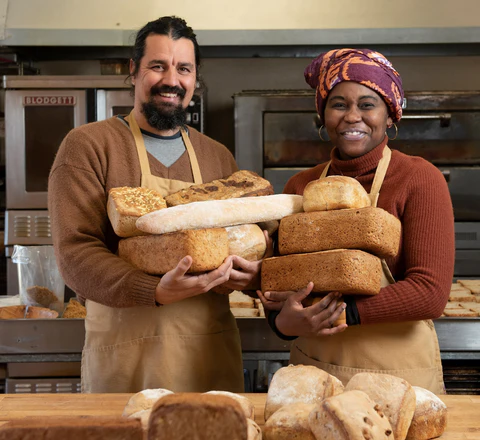
Featuring:
André & Jessica Kempton
“Husband and wife team Andre and Jessica Kempton launched their small family business Wild Leaven Bakery to strengthen the local food economy in Northern New Mexico, one loaf of bread at a time.
Wild Leaven Bakery is a small family-owned and operated business that specializes in long fermentation sourdough bread using organic, local grains and ingredients.”
Information from the Wild Leaven Website
Photo Credit: Wild Leaven Bakery
Episode Transcript
Bunny : (00:00)
Hi there. I’m Bunny Terry, and you’re listening to the I Love New Mexico podcast. Whether you’re a native new Mexican, who’s lived here for your entire life, or you’re just considering a visit, this episode is for you. Join us as we share a lot of New Mexico’s stories, talk about all things New Mexico, and include topics like what’s magical here, where you ought to visit, what’s happening, and the things you absolutely cannot miss in the land of Enchantment. We’re excited that you’re here and we can’t wait to show you what an amazing place New Mexico is, because let’s face it, I love New Mexico.
Bunny : (00:51)
I’m so excited to talk to today’s guests. I have a husband and wife team. I have Jessica and Andre Kipton, who are the owners, the, the founders, and the owners of Wild Levin Bakery, which started in Taos, and you now have a second location in Santa Fe. And, um, I, I have to make a confession. I haven’t been to the bakery, but I’ve heard a lot of great things about it. So I’m, I’m going this weekend to your location in Santa Fe, but tell me, first, tell folks, um, who you are, how you ended up in New Mexico. Perhaps you lived here all your life, um, and if not, how you ended up here and, um, why this bakery in these spaces?
Andre : (01:39)
Alrighty, sure. My name’s Andre Kempton. Um, I started Wild Leaven Bakery about over 10 years ago, and I had been baking for about five years, learning the trade, and I decided to, to start, um, fresh and start my own bakery. So, uh, fortunate enough I was able to, to get a foot in the door in the bakery business and, and get a spot at the Taos Farmer’s Market. And this was, um, 2012. So I started baking small scale, renting a kitchen, and, um, that was the beginning of the bakery. Um, my wife and I have been running the bakery now for six years about, so that’s, that’s a little bit about the, the start of the bakery.
Jessica : (02:34)
Yeah. So, yeah, I think that’s what coming is after we get married and all that. And it naturally, it, it wasn’t like, oh, we get married, we run the, the business. But I definitely enjoy being part of the business and, and assisting with administrative staff, marketing, branding, um, hiring. Um, so that’s why I come in for sure. And of course, we brainstorm, we, we make decision together. Um, it’s certainly, uh, a joy to work by my spouse. And, and I also, um, personally, uh, teach online courses, communication courses, um, and that’s, and I have my own little marketing agency, so I have several heart, but in terms of being part of WA and Bakery, um, has a co-owner, it’s certainly fun to be able to support, uh, the vision that we have to provide healthy, nutritious, uh, bread and food items to our community.
Bunny : (03:39)
You know, and this could be generational, but you know, Brad kind of gets a bad name in, in the health, health and fitness world. And so I, I want you to tell me, tell me how healthy it is to eat lots of bread, because I do
Andre : (03:55)
Jessica : (07:55)
So not all bread are created equals in one sentence. And as this, he kind of definitely went in this technical explanation, and I think it can be overwhelming if someone ever heard that. And like you said, the quality of the ingredients is the first start, and that’s why we certainly, uh, want to emphasize and then the process has, he explained all that. So I, uh, definitely enjoy eating. We enjoy eating our own bread, uh, so much because, um, the bread that we found in, you know, other competitor and general, the, if we compare how it’s been made, it’s certainly different for us and small batches. So, um, there’s so many layers where talking about, uh, bread being bad, it’s like saying that the food we make in our home is bad for us. We cannot imagine feeding ourself toxic things. So, and um, as you mentioned, a lot of people, it got a bad rap because the way our food industry has gone and, uh,
Jessica : (09:14)
So it’s not just the bread, unfortunately. It’s how we are taking care of soil, how we, um, take care of our own body and what we select to eat. So as a family, actually the budget of our, uh, food, uh, intake is actually a big one. I mean, we, we make sure we get the best ingredient for ourself and we feel like this is how we should also offer, we should do for our business or our customers, because healthy is not, it’s certainly important and but nutritious too, it doesn’t have just to be healthy has to be sweet and good and all that good stuff.
Bunny : (09:51)
So we’ve been talking for nine minutes and you have both said things that, um, I, and, and I’m 61 years old that I, things I didn’t know before about bread. Like I didn’t know that the fermentation process could eat up the dreaded carbohydrate, which is of course not a bad thing, but it has carbohydrates have gotten a bad, um, wrap as well. Um, but I have as, as almost everybody who is familiar with me and who maybe listens to this podcast knows I have, um, I had stage four colon cancer 10 years ago. So when you were opening the rest, the bakery, I was in the midst of a health crisis and, and I had about 12 inches of my colon removed. And after that time, I discovered that gluten was much more difficult for me to process. But you just said that the fermentation process takes care of a lot of that. So what, so, um, your just, I, I mean, I read a review on your website where a woman said, I’ve been sensitive to gluten all my life, and suddenly I found bread that agrees with me. Is that because you have a gluten-free bread or just because the process takes care of that? I’m really curious
Andre : (11:12)
Mm-hmm.
Andre : (12:12)
Um, so for example, in our s sprouted rye breads, we have all the, the rye flour I mentioned from Southern Colorado. And then we also add sprouted ribe berries, sunflower seeds and oats. And, um, so we steer people towards those types of breads that maybe don’t have any wheated at all. Um, and people start eating them and, uh, they actually can digest them. They don’t have problems of bloating or problems of indigestion or heaviness because the, the grains have in the flowers have been processed, uh, so thoroughly through fermentation and, and sprouting. Um, we also do have a gluten-free bread. We don’t have a gluten-free facility, but we have a gluten-free bread that’s sourdough, organic whole grain and, um, gluten-free, which is hard to find. So, uh, we do offer that. And that’s a buckwheat base, um, uh, a dark whole grain buckwheat bread that’s sourdough. It’s also organic and uh, no weird binder. So we use flax seed meal and chia seed as, uh, binders that help bind the bread. Um, but even our regular, uh, say baguette, which has 20% local heirloom sonora wheat and 80% organic bread flour, which is more of a white, uh, bread flour, even that bread, people will say, I can eat this bread and I have no problem because that also has a long 24 hour fermentation. And, um, it just makes it that much more digestible. Mm-hmm.
Bunny : (13:58)
Andre : (14:12)
Yeah, it just depends. So the highly, highly yeasted commercial breads, they’ll mix commercial yeast with the dough, and it might, it might have one generation of, of yeast growth, which is like 45 minutes. So it might rise for about 45 minutes and then get baked. Now if you go to the other end, you have, uh, now bakeries are shipping their bread all all around the country and you get some, some artisan sourdough bread on the, in the supermarket. Um, and sometimes that’s four to five hour, uh, fermentation, the final fermentation. So, uh, and then some bakeries, a lot of local artisan bakeries will do the longer fermentation, obviously. And, and nowadays it’s popular to do an overnight fermentation in the refrigerator. So that’s also another method bakers use. The majority of our bread is fermented at room temperature and it takes longer cuz we use a smaller amount of, uh, the sourdough culture to begin with, but some of our bread is fermented overnight in the fridge. Um, so
Jessica : (15:21)
Yeah. Yeah, it’s just, it just depend. I mean, we, we cannot speak for other bakeries, but uh, we know that, um, humans are behind the bread we’re making. Um, and as I learned from, from my husband Andre and our head baker for wa baker for sure, as you can tell, um, it’s not, it’s not always, uh, specific formula. Some days you just have to be, you definitely have to be close to, uh, the, the bread ferment because as the temperature will change, he generally has to, uh, also adjust, uh, what is going on in the kitchen. It’s, it is very, uh, for those who make bread and let me understand better, but he can elaborate more, but it can be, uh, right now in winter, right, it’s gonna get warmer. It can take us a whole three weeks to, we are just, uh, everything and feeding the starter and all those things. Sometimes I just have to say, okay,
Bunny : (16:28)
So I’m curious, I mean, my husband, um, went to school to get a chemistry degree and, and the baking bread process is his favorite. I’m not saying he is baked any bread in the last couple of years, but he’s more fascinated by that process. And that’s what it sounds like you’re saying is that it is, is that it’s so, um, so dependent on, um, so many different factors that you gotta, you have to be, you have to almost, you have to be an artist to get it right? Yes, I think, yes. Um, yes. And it’s, well, it’s not left a chance. So, um, yeah, maybe artists, I don’t, I don’t know what the right term is, but um, obviously you guys know what you’re doing.
Jessica : (17:08)
Yeah. That’s why we, we call our self artisan bakery in that sense because it’s certainly an art and I, I’m very myself still, um, uh, very, we have different, one thing I’m not sure for those who don’t know is we have different type of saddle bread. So it’s, it’s not just one type, but our most popular is like it’s original saddle, sunflower saddle and, uh, Ram Saddle brand. And then some people like the German one. So even then when we think of the, the, we talk about bread, it’s a world that myself, I discover over town and say, okay, I knew about baguette, I knew about certain things, but they said it’s a whole world out there of what, when we talk about bread, you know,
Bunny : (17:54)
Well, and during the pandemic, uh, and and congratulations to you for surviving that, but thank you. Everybody suddenly became sourdough bread,
Andre : (18:29)
That right? Yeah. We probably have like up to a do a dozen different sourdough breads. So we, yeah, we specialize in sourdough breads. We do have a few breads, um, like our challah, which is yeasted commercial yeast. Uh, but that’s also, we do a technique where we ferment that for 24 hours. So even when we do use commercial yeast, say we have, uh, bread and TAs, which it’s a half sour to half yeasted baguette that is also fermented for 24 hours. So commercial yeast is not bad in, in itself. You, you can ferment commercial yeast for 24 hours, um, or longer, and you can achieve a lot of the similar, um, you know, results. But the sourdough creates a lot more flavor and depth in the bread. Cuz there’s so many different strands of, um, culture microorganisms, yeast strands, and bacteria strands in the sourdough culture where the commercial yeast, you have one variety of yeast and that’s it. So it’s very limited profile of flavor and, and et cetera.
Bunny : (19:39)
Okay. So this is something I’ve never understood, and in fact, when I said I was gonna do this podcast, my husband said, you have to ask this question, but Uhhuh
Andre : (19:55)
Yeast. Yeah, so that’s a good question. Um,
Andre : (21:07)
They’re in there. Um, and the yeasts have a relationship with, uh, plants. So the yeast grow on the plants and help protect the plants from other bad yeasts or bad fungus or bad bacteria. Mm-hmm.
Bunny : (22:29)
It’s amazing
Jessica : (23:04)
You said 11.
Bunny : (23:05)
If I come into Wild 11 Bakery for the first time, what should I get as a newbie? Besides everything
Jessica : (23:13)
Beside everything. Um, so I, I, I think we like to tell folks to start with the original saddle of bread. Ask a team member, I would like to have original saddle of bread. The good news is we, we selling pounds. So we have large loaf, but you can start for small, smaller one one pound and uh, okay, go from there. We do have quinoa. One of my quinoa on far is just the, the saddle, the original saddle of it with some, a quinoa seed in it. So I like it because there’s a, and then, uh, that, that would be a good start, just, but Salk, that’s the short answer. Salk
Bunny : (23:52)
Andre : (24:02)
Yeah. Oh, from us. He buys it.
Bunny : (24:05)
No, no, he buys it. You know, he lives in San Jose, but he’s the one who made the sourdough. Oh yeah. I’m
Andre : (24:11)
Thinking Chala. Yeah, challah makes fantastic french toast. So we do challah every Friday in Santa Fe right now. And, um, we have the braided traditional braided challah and then also Little Sandwich Hollow loves.
Jessica : (24:27)
And then I want to add that we, we also a big part of the, um, towns farmer’s market community. So, uh, we gonna start in May. Uh, so it’s like six months, so we are gonna be having a booth there on Saturday. So we, we love going there as well as a family, but we have our stand there too during the farmer’s market season in Taos.
Bunny : (24:53)
Okay. So where are you in Taos? What is your
Andre : (24:56)
Location? We have a brick and mortar on the main drag poeo, uh, um, Pueblo Norte. Um, we’re in the Yakka Plaza. Uh, we’re excited to be moving to a new location, uh, at the end of the summer in North Taos where we’ll have sit down and we’ll have a wild 11 bakery and kitchen and, um, it’ll be a very unique, uh, we think unique, um, we call it a bio-regional bakery and kitchen. So it’s gonna be a unique dining experience and, uh, we’re excited about that. Um, our location now is, uh, right across the street from Kit Carson Park, downtown Taos, and then mid-May. As, uh, Jessica mentioned, the Taos farmer’s market will be starting and we will be in the Taos County Courthouse parking lot this year.
Bunny : (25:50)
Did I see on your website that you also have soups or is that what you’re going to do in the kitchen going
Jessica : (25:57)
Forward? Yeah, we do have, uh, soup, uh, we offer, uh, soup now as we speak, um, in both locations. Uh, generally it’s one soup of the week and, uh, when we open to the new location, we, we gonna expand our sum menus for sure. So, um, yeah, that’s, and I just want to say we are open Wednesday through Saturday, eight 30 to two, so, but the hours on the website, so the, the soup is certainly something that is good for lunch, you know, um, takeout, uh, for sure for now that’s, that’s maybe for those who don’t know us so far, we are, we are doing takeout, um, on the, in the house shop right now. People can sit on the patio, has weather permit, but then the new location, uh, gods willing, we can have everyone sitting for as long they need to have to enjoy the soup and, and all that good stuff. Anger with friends and family.
Bunny : (26:51)
Well, and and what’s the soup this week? Because I may need to go get some tomorrow
Andre : (26:54)
Bunny : (27:00)
What wow.
Andre : (27:02)
Bunny : (27:07)
Which would be perfect in a sourdough, in a sourdough bowl.
Andre : (27:11)
Jessica : (27:13)
Would be, and then you can, you can have your soup with a choice of bread. That’s another good way to try a different bread. You say, you said to a team member, oh, I like this type of bread. So that’s a nice way we invite folks to try, you know, you get the slice or two depending of the amount of soups you’re getting, so you go home and try that bread and say, okay, I like that. I can get a little more next time. So soup is another good way. Uh, we, we like to encourage our, our community to try different bread safely. You just have a slice or two
Bunny : (27:45)
And do you do, um, any online? Cuz I know a lot of our, a lot of people who listen are not in Santa Fe or Taos.
Andre : (27:54)
We don’t do any more online sales. We used to do, uh, shipping for our breads, but we were just having too many issues, um, with the post postal, uh, service was such a fragile item, so we stopped doing that. Um, and we used to do wholesale to grocery stores, but we decided to focus on retail, and now everyone is coming to the shops, our two locations, and that works out great. And, um, so yeah, that’s, that’s what we’re focusing on.
Jessica : (28:23)
Yeah. A small business as you say. Thank you for actually, I’m ready for surviving, uh, the pandemic. That’s the different cause that you have to, you want to still offer this product to your customers and keep your business running too. So it wasn’t an easy decision, but it’s where we are
Bunny : (28:47)
Go ahead. I think it’s great. I think it, I mean, I’m, first of all, I’m always excited that, um, that small businesses are thriving, especially in, in small com. I mean, I, you know, Taos is a smaller community, so it’s so, and you’re very, you’re really involved in that community as I understand
Jessica : (29:07)
It. Yes. We are
Bunny : (29:12)
Yeah. Yeah. And it’s, um, and, and that’s, I mean, that’s what this is all about to me, is, um, s supporting small businesses and, um, small communities. So I’m very excited that that’s working out so well for you. So what else, if you were gonna tell our, if you were gonna tell the people who are listening today, um, you know, if they’re coming to Santa Fe Taos in the next six months, tell them what not to miss. Um, besides what you’re doing, I mean, I, I want them to, I want them to find you and, and buy a loaf of bread and then go somewhere and enjoy it. What do you think, what’s your favorite thing about Taos?
Andre : (29:52)
Oh, okay. So, um, Taos and Santa Fe, we love the mountains. So, um, we are big, big, uh, avid hikers. And during the, uh, summer seasons, the summer season, um, there’s a lot of, uh, mushroom hunting going on. Yes,
Jessica : (30:40)
Does, it doesn’t cost anything like just, you know, going camping. There’s a lot of free places. Um, and I can’t remember the names, but what was the last place we went camping?
Andre : (30:52)
Oh, we love to go up to the, uh, tus Mountains, which is north of bb. Oh
Bunny : (30:57)
Yeah.
Andre : (30:57)
And, um, there’s some amazing high lakes up there, beautiful high lakes, um, during the monsoon season. Um, that’s great. Uh, mushroom picking territory,
Jessica : (31:10)
Bunny : (31:45)
I, I’ve lived here all my life and I never get tired of that drive. That’s a really amazing drive. And when I was a child, we used to camp near Sippa P so, um, so that’s, that sort of feels like home to me. But, um, I’m, I, I’m, I gotta tell, I took a bunch of notes. I wrote down all these notes. I’m still really curious about anti-nutrients, but we’ll talk about that the next time we do this because I, I’ve never heard that word bef I’ve never, that’s never been in my, um, vernacular before. So, um, I’m, I’m, I’m so excited that we had this conversation because I learned so much. Yeah, yeah. I, I did wanna ask you one more question. Tell me about sprouting. What is that? I mean, I just know that if you’re ever ta thinking about going low carb, there’s this whole swirling thing about sprouting.
Andre : (32:38)
What is that? Yeah, sprouting is activating the, the process of the seed, the growing process. Mm-hmm.
Andre : (33:39)
So you can grow it for, we grow, we sprout our grain, uh, for three days, and you get a nice, um, growth. And what that does is, um, the plant is using the carbohydrate as energy to, to grow. So it, it’s e eating up the carbos. And then, um, it also is releasing all kinds of beneficial enzymes. The growing process releases enzymes and sugars. So if you sprout things, they become very sweet. That’s why we sprout barley, and then we make beer with it because it becomes, it creates tons of sugar. So the sprouting does all of that, and then it be, it’s alive, it becomes more nutritious, it eats up the carbs and, um, yeah, it releases beneficial enzymes.
Jessica : (34:27)
Yeah, we, and we, we do have, uh, pastry too. I mean croissant, I mean this is a lot of thing, but we wanted to make
Andre : (34:33)
Sure. Yeah, we specialize in french pastry. So we do the whole handmade, uh, process of, um, french pastry. And we do a long, also a long fermentation, a long rise on that. So that gives it flavor. So the croissant, we have cinnamon swirl, chocolate croissant, we have, uh, green chili cheese croissant, Hammond cheese croissant. We have empanada, we have, yeah, we have empanadas, we do scones, cookies. Um, and for the French pastry, it’s called lamination, it’s called, the French term is vie ri, that’s the laminating process. So you get, you’re gonna be, you’re getting 27 layers in your croissants of dough, butter dough, butter. And you have to do that by folding and taking your time and rolling it out. So it’s a very in-depth process. And, um, the Santa Fe reporter just added two new categories to their best of, so for 2023, we are, um, nominated as best croissant and best bread in Santa Fe. Yay.
Bunny : (35:43)
Yay. Okay. Well this is gonna, this will drop on, this is gonna drop at exactly the right time for people to start voting. So that’s very exciting. We
Andre : (35:53)
Have three weeks, I think, to vote. Yes.
Bunny : (35:55)
Awesome. So I’m very excited for you. We’ll, we’ll promote that. And, um, I gotta go, I gotta go buy some bread. Thank, thank you so much for, so thank you so much for talking with me. Thanks.
Andre : (36:08)
Take care. We’ll see you at the shop. Hopefully

About the Podcast
Recent Episodes

I Love New Mexico Teachers: Bunny Terry
About the Episode: Summer is coming to an end and a new school year is...

I Love New Mexico Food: Kirk Muncrief of AlbuKirky Seasonings
About the Episode: In New Mexico you know we love food AND we love spicy...

100th Episode Recap: Bunny & Johanna
About the Episode: The I Love New Mexico podcast has made it to 100...
 Bunny Terry is a native New Mexican who grew up on a farm in northeastern New Mexico. Her first writing job was typing stories on index cards on her family’s Underwood, stories that were uncannily like the ones she read over and over in O Ye’ Jigs and Julips, her favorite childhood book. No one thought to save those index cards for posterity, although there is the theory sarcastically circulated by her siblings that they will certainly be worth millions someday.