About the Episode:
Imagine if you were a perfectly healthy person going about your life, and then one day, out of the blue—wham!—you’re diagnosed with stage IV colon cancer, and told that you may not survive. Would you, in this most difficult of circumstances, find the wherewithal to be grateful? That’s exactly what Bunny Terry did, and in this inaugural episode of the Lifesaving Gratitude podcast, she recounts her own cancer journey, with the help of her daughter Johanna, and they both found gratitude to be a superpower that would ultimately help her to survive her battle with the disease.
Resources mentioned in the episode:
Subscribe to Lifesaving Gratitude on your favorite podcasting platform






Featuring:
Bunny Terry & Johanna Medina
Bunny Terry is a native New Mexican who grew up on a farm in northeastern New Mexico. Her first writing job was typing stories on index cards on her family’s Underwood, stories that were uncannily like the ones she read over and over in O Ye’ Jigs and Julips, her favorite childhood book.
Learn more about the podcast.
Episode Transcript
Bunny: Hi everyone. Bunny Terry here. If you haven’t met me before, I am the author of a book called life saving gratitude, and this is an exclusive listen to my new podcast by the same name, lifesaving gratitude. It’s going to come out every week on Spotify, Apple, and hopefully wherever you find your favorite podcasts.
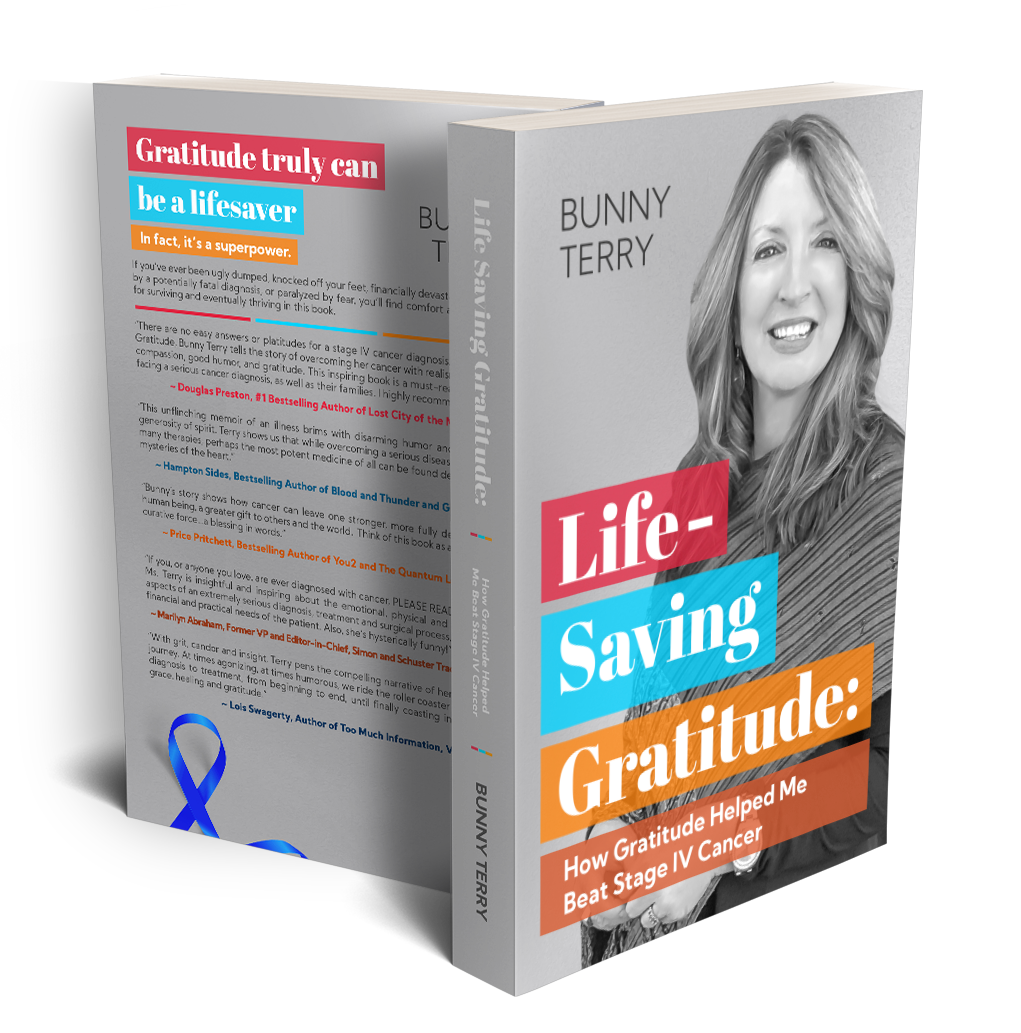
Life saving gratitude is a central idea in my life. I wrote a book about it because it’s the truth for me. And the truth is that gratitude can save our lives, if we just tap into its power. I know personally that gratitude is a superpower. It can transform you. It can even save your life.
I discovered the lifesaving power of gratitude when I was diagnosed with stage four colon cancer, which we’re going to talk more about in this episode. And I’m also going to bring in the producer of my podcast, my daughter, Johanna Medina, who was my caregiver at the time that I was diagnosed.
In the coming weeks we’re going to interview a wide variety of guests: people who have used either the art or the science of gratitude to change their lives. I know some people who study gratitude for a living, and what it does for you health-wise and what it does for your mental health. I’m going to talk to people who have interesting stories about grief or illness or hardships that they’ve endured and the ways that they’ve survived and then thrived by using gratitude in their lives.
Because of all the things that happened to me—and a lot of them that piled up on top of each other the year that I was diagnosed—I know firsthand what it’s like to go through it. If you have ever been ugly dumped, or you’ve been knocked off your feet, or you’ve been financially devastated, or you’ve had a potentially fatal diagnosis, or you have experienced grief in your life, or you’ve been paralyzed by fear, I hope that you’re going to find comfort and inspiration in the powerful conversations and stories that we’re going to talk about here.
My book is mostly about my cancer journey. It was a year really when I thought that the earth should have tilted off its axis because of all the icky things that I thought were happening to me at the time. But the book is also about how, when I looked back, I discovered that gratitude had been this really amazing vehicle through which I filtered my grief and my fear. And I know now that gratitude was just as important as the medicine and the healthcare that I received.
So I’m not an expert on anything other than what works for me, but lucky for you, I’m going to find the real experts and the folks out there who understand the science of gratitude even better than I do. I want to be really courageous and really curious about what gratitude did for me and for a lot of other people.I want us to find different ways to exercise gratitude every day in our life. I want us to find ways to continue to stop when we’re in the midst of something negative and just say, thank you. Thank you. Thank you. I just want to talk about everything connected to gratitude in a way that works best for you.
When we were coming up with the central ideas that we wanted to talk about in this podcast, I said that I don’t want this to be like Cafe Gratitude. I don’t want this to be boring. I don’t want people to find it bothersome. I don’t want to sound all flowery and namby pamby. I want this to be less gratitude cafe and more gratitude biker bar. I want us to get really down and dirty and kind of bad-ass about the truths about life and how gratitude really works. Because I’ve got to tell you, it’s really sort of magic.
So if you happen to know somebody who’s been kicked in the head by life, the way that I was, and then they lived to tell this story, I want to talk to them. I want to hear their stories of survival. And I want to share them on this podcast.
You know, life asks a lot from us. It’s exhausting and it’s frightening. And it’s really hard at times. We’ve just lived through an unprecedented year where I’m pretty sure you didn’t feel very grateful every day. I mean, there were those days when your kids were running through the house saying that somebody needed to wipe their butt while you were on a zoom call. And I’m telling you that’s a true story, because it happened to my son. Or when you were thinking that you might chew your arm off just to be able have a meal in a restaurant with a glass of wine.
This was a year when gratitude felt really hard to conjure up. But unlike all those designer masks that you bought and all that stuff you ordered on Amazon, gratitude is free and it’s right there all the time. You just have to grab it and open your mind. You have to stop where you are and you have to say, thank you. Thank you for this moment that you’re in right here right now. And that’s hardest when you’re in the middle of a year like the one we’ve been in.
But we can’t grow and we can’t add to the world if we’re not in the immediate moment. If you’re stuck in last week, and you’re thinking about something stupid that you said on a zoom call, or if you’re like me and you’re lying awake at night, thinking about that one mean thing that you said to somebody on the playground in the fourth grade. Or maybe you’re projecting into next week or next year and you’re worried about a project or a new job or a move you have to make. When you do this, you’re not contributing to the world, because you’re not being in the present moment. And that’s what gratitude is about.
I mean, I’m sort of scared to death to be doing this podcast, but I’m really, really grateful that I’m surrounded by people who know how to do it, and who inspired me to do it. So if you’re choosing to be grateful every single day, science and my own really practical experience say that you’re going to be grounded in the present.
And by the way, I use that phrase all the time: Thank you. Thank you. Thank you. I learned it from Anne Lamott, who’s one of my favorite authors. She says it’s one of the best prayers in existence. It’s one of the best three prayers in existence. The others are “ please, please, please” and “help, help, help.” So one of my favorite ways to conjure up gratitude is just to say, thank you, thank you, thank you.
The reason I’m here and the reason that we’re doing this podcast is to bring you a little tip every week that’s going to help you get more gratitude in your life. And I don’t say that lightly. Gratitude is so important. I had a year when I didn’t know if I was going to have a second year and it was just by learning to say, thank you for this moment, this instance right now that, that I was able to get out of bed.
I want it just take a moment for those of you who are here because you’ve either read the book or you’re curious about it. The name of my book that was published in January of 2021 is Lifesaving Gratitude. You can find it on Amazon and you can also find a link on my website, bunnyterry.com. Just a warning that when you put “Bunny Terry” into Amazon, you’re probably going to come up with a bunch of little kids clothing that is made of terry cloth that has a rabbit on the butt. That’s a plug for the book and I am excited to talk to anybody who’s read it and has questions. Feel free to email me at any time. My email address is on the website.
One of the things that I think is most important for you to know going into this, is who the people are that helped me get through that journey. And Johanna Medina, who is my daughter, was one of the most influential pieces of my survival. She was my caregiver. She came the day that I was diagnosed. I was single at the time and I was living alone, which seemed to really distress my oncologist. Johanna came in and sat on the end of the bed and said, “Mom, I’m gonna move to Santa Fe. I’m going to be your caregiver.” So, I don’t know if we can get through this episode without shedding a few tears, but we want you to know our story and I want you to know about my cancer journey.
I’m going to give another plug for the book only because that’s where you get the real story. That’s where you get the most information about how gratitude saved my life. But, I just want you to hear some of our stories. So Johanna you’re there, right?
Johanna: Yeah. I’m here. I mean, if we start talking, we will just talk forever. But I definitely want people to read the full story in the book. I think it’ll be interesting for us to talk and have me have a little bit of my side of it too. I mean, I was part of your writing process and definitely read all those first drafts. So my side of it’s in there a little bit. But this is going to be fun to explore your experience more and explore gratitude with all of your upcoming guests. I’m really excited about that.
Bunny: I am too. Let’s talk about a couple of my early guests. I have a woman who’s an executive coach and taught at George Mason University, but she’s done extensive work studying how gratitude affects people—both their mindset and their ability to reach goals. So I’m really, really excited about that.
When you and I started on this journey, we didn’t know that gratitude was going to be a part of what worked. In fact, even as I was writing the book I didn’t really know. Even as I was getting up every morning and writing a thousand words while I was sick, I didn’t know that gratitude played such a huge part of it. It wasn’t until I went back like six years later and started reading the manuscript. There was a lot of it that felt really whiny and I thought, “Oh my God, I can’t believe this is the year I’m having. I thought it was the healthiest person alive.” And I couldn’t believe that I had cancer of all things. I thought maybe I had an ulcer. It was only by going back and looking at my journal that I discovered that gratitude was such a big piece of it.
So I think it’s cool that now we’re developing this vehicle where we can help people going forward. Instead of looking back at the hardships in their lives, they can look forward and say, “Here are the best ways for me to go forward in my life. Here’s the best way for me to reach that goal. Here’s the best way for me to get through this really harrowing part of my life.”
So I’m excited about that, but the day that Dr. Lopez came in and sat at the end of my bed and said I had cancer, we didn’t feel very grateful. Did we? No. No.
Johanna: It actually started even a little bit before that. Even in your colonoscopy. You were in the hospital the night before, but that colonoscopy was the memory that I have as first hearing that you had cancer. And that is not the person you’re supposed to hear it from. I don’t know if any of your listeners out there are Grey’s Anatomy fans like I am, but I can tell you now watching it: I know you’re not supposed to get a cancer diagnosis from somebody who’s not an oncologist. That’s just not real. But you unfortunately got that from the person you weren’t supposed to hear it from. You weren’t in the position to hear that. I mean, there’s a reason that it’s supposed to come from that official doctor.
But yeah, I remember that reality hitting, and it was totally like a movie or something, so surreal. We just did not imagine that that’s what the doctor was going to say. And it really changed our life. It turned everything upside down and we had to figure out how to, as a family, keep going and how to get you treatment. There were just so many things in front of us that we didn’t know how to deal with. There was so much unknown and so many questions. It’s so crazy to look back at that time. It was a little more than eight years ago, but when I think about it, it feels like it was just yesterday.
Bunny: Well, we’ve made a lot of miles since then. Just for background, I was really healthy and I had pain for one night. I’d gone on a blind date and I was kind of sick, but it wasn’t bad. I mean, I was 51 years old. Who goes on a blind date at that time in their life? But, you know, I’m an eternal optimist. I go on this blind date and I felt kind of icky all day long. And I thought this blind date is making me sick. But it was really the first day that I had had any significant pain.
That was less than 48 hours before I had the colonoscopy. That Gastroenterologist came into the room—you were there with granny and my parents—and he says she has a tumor in her ascending colon and another one on her liver, and we don’t even know if this is treatable. There was not much gratitude in our life at that moment.
But luckily, I was raised by the two of the most optimistic people in the world. And you were still, well, I have to apologize because I don’t really remember how you were on that day.
Johanna: I mean, I’m sure it was a blur for you. Yeah. It was a rough day for sure.
Bunny: Yeah. And then the next day the oncologist came in and explained to us that I had a five and a half centimeter tumor in my ascending colon. And I had a four and a half centimeter tumor on my liver. If you’re like me and you don’t really know the metric system, that’s a small plum. But nobody wants a tumor of any size.
That was the day that my friend Suzanne called and left a message and said, “You know, you ought to start a caring bridge post.” A caring bridge is this platform for people who have illnesses. It’s a platform where you can blog about your experience. But what I’ve found is that the first time I did a caring bridge post, I really talked about being grateful, even when I didn’t feel like it. And I think that’s the thing that I want people to take away: you may not feel grateful all the time, but there’s just magic in expressing it. Don’t you think?
Johanna: Yeah. I mean, being grateful might not be easy, like you said, during whatever you’re going through or from day to day, but taking that time to maybe dig a little deeper and try to find some of that awareness is going to be really beneficial for you. Spending that time to be mindful about your day or your week or what you’re going through. That in itself can be life-saving or life-changing. So just having that practice is huge.
Bunny: Well, the way I understand the science is that your brain chemistry changes when you choose gratitude. We’re going to have an expert on the podcast to talk about that. This is all information that we’ve read elsewhere, but when I was doing some of the research for the book I found studies showing that just the fact that you choose gratitude, as opposed to choosing negativity, changes your brain chemistry a little bit.
Johanna: Yeah, it does. That mindset and that switch in your brain, affects all those stress hormones. Again, I’m not an expert, but I have heard that can have a big impact. It seems like a small thing, but it makes a big difference.
Bunny: It really does. When we started that journey, there were so many things that were not right. I mean, I didn’t have insurance at the time and I’m grateful that there was a pool in the state for people who didn’t have insurance. But at the time I was thinking, “I can’t be grateful about this because I don’t even have insurance and I’m facing this exorbitantly expensive treatment.” I was really grateful that you were coming to live with me. You were living in Albuquerque, which was 60 miles away, but you were going to basically give up your last year at school. I mean, you were going to continue to go to school, but you ended up taking all of your classes online, right?
Johanna: Yeah. I mean, it’s funny how it just worked out that I was able to finish my last year of college online. I just knew that that’s what I needed to do. It was for you as much as it was for me. You know, to be closer to you, to be able to go to all your appointments, and to help you. So it was kind of a no brainer to do that.
It was a hard time and it certainly wasn’t fun. You going through treatment was—I mean, I can’t even imagine living in your body at that point. But I remember us having a good time. It was nice to spend time with my best friend. I think we made the most of it.
Bunny: We had a great time. But for any of you who have never had a cancer patient in your household, they’re really persnickety, right Johanna?
Johanna: I think you had every right to be, but yeah.
Bunny: There was a group of women at my church who gave us a freezer full of soup. In fact, if you know a cancer patient, this is the coolest thing in the world to do. We have close friends right now who are going through a really difficult time with a cancer diagnosis. And I will be eternally grateful for that freezer full of soup. I mean, these women just got together and they had a little dinner for us. And then they gave us something like a month’s worth of soup that we could put in the freezer. That was amazing. We would come home from treatment and I really felt awful. I was exhausted and my mouth tasted like I had a handful of dirty dimes in my mouth. It was so gross. I was just so exhausted, and then Johanna would say, “So do you want chicken, chicken and dumplings, etc?” She was naming all these soups . Then I would say, “I don’t.” I was like a four-year-old. “I don’t want any of that.”
Johanna: You didn’t feel like soup. I mean, it’s totally understandable. I think that is the best advice for anybody with cancer or any major illness or even new parents. Make them a meal and just either give it to them ahead of time or drop it off. We don’t really want to spend time with you or see you. Just give us the meal. That’s the most helpful thing.
I mean, you don’t know if you’re going to feel like eating at that point, especially if you’re going through chemo and you feel so sick. I mean, we live in Santa Fe, the land of amazing foods. Anytime you wanted something, I was happy to get it, but it was usually just mashed potatoes.
Bunny: Yeah. You learned how to make a mean batch of match potatoes, didn’t you? And we watched a lot of really mindless TV. We watched a lot of Downton Abbey, which was really amazing, and we got through it. I think that we made the choice to just kind of put our heads down and move forward and just see.
People have gotten in touch with me since they read the book and they say they think of it as the Bunny Prayer, but I had the Martin prayer. Martin was our pastor at the time. And he talked about just seeing the one thing that was in front of us. And I think that’s another important thing to be grateful for. You don’t have to conquer the entire world. Just like, we only have to do this one podcast episode and then I can get over my nervous about it, and then we can go onto the next one. I think that’s important. If you can be grateful and you can be in the present moment, then you only have to do the one thing that’s in front of you, right?
Johanna: Yeah. I mean, it just doesn’t do you any good to worry about the future. You can’t help but be anxious sometimes, but it really just doesn’t do any good to worry about tomorrow or next week. Because you really don’t know what’s going to come of it. I’m probably such a hypocrite to say that because I am the most like Type A planner person. I think that’s why it was good that I was there to help you. Because I would keep track of all of the appointments, plan our day, write everything down, and know what was coming up next. That was a lesson for me too: Learning that life is unpredictable and it’s going to throw things at you and it can change in the blink of an eye. And if all you have is a couple of things to be grateful for that can get you that day or that week, or that tough year that you’re going through. And also to know that as quickly as things can change for the bad, they can change for the good as well.
Bunny: Right. Yeah. I was just thinking about how one of the things that I didn’t dare think ahead about was the fact that I might not be a candidate for surgery. We knew that after a certain number of chemo treatments we would hopefully get to go and see a surgeon who could remove the tumors. One of the things I didn’t realize when we first started those treatments was that I might not qualify for surgery. I mean, if I had known that and been able to think ahead, it would have been a lot harder to go to chemo every two weeks. I mean, it was pretty grueling. I went every two weeks and had to be hooked up to a pump for 48 hours. If I had known that at the end of it all, I might not be eligible for surgery, it would have been a difficult hurdle for me to overcome.
But then we went to the surgeon and were told that there would be two options. Either he’s gonna say, “No, you’re not a candidate,” or he’s going to say, “I’m going to cut your gut open and I’m going to take big pieces of your colon out and I’m going to lop off the corner of your liver.”
So here’s my best advice: if you know all that stuff in advance, act like you don’t, because projecting that far into the future will kill any grateful feelings that you have. I think you’re really going to have to be purposeful.
Johanna: Yeah. I mean, I don’t know if it was just me, but I don’t think I ever had a thought in my mind that you weren’t going to be eligible for the surgery. I think we tried to stay as positive as we could about it. I mean, you also say in your book that on the hard days you weren’t positive, but I think overall, we were just like, “Okay, this is going to work.”
You get over the initial fear of this is cancer. I hate to say it, but when you hear “cancer” the first time, you think you might not survive. That’s your automatic thought. I don’t want to say we got over that fear, because I think that’s always in the back of your mind, but at some point we realized, “Okay, we got to do this. You’re sick, but you’re alive. We’ve got to do what we can to get through it.” We tried to be as optimistic as we could be. We thought, “Okay, well, the doctor said we do these mini chemos and then surgery and then chemo again, and then we’re done. So that’s what we’re doing. It’s going to work.” I guess that’s the type of people we are.
Of course it doesn’t always work out that well for everybody. Some people don’t recover, and it’s terrible. It could be any kind of situation too; not just cancer. But I think having this mindset and knowing that in this type of situation, especially with cancer treatment, so many things are out of your control. You don’t even know the type of like chemo drug you’re going to get. There’s so many different ones and you might have a few different choices, but not a lot. A lot of things are out of your hands. So if you can take a little bit of control over your mindset, over perception of things, that’s going to give you peace of mind and a better grasp on that journey.
Bunny: Wow. That’s so wise. I hadn’t thought about the part where you really don’t have any control when you find yourself with any kind of life-threatening illness. I just think about people who are experiencing really deep grief right now. There are so many things that we don’t have any control over. But like you said, the one thing you do have control over is how you react to things and what your perception is.
I’ve been accused of being really Pollyannaish and I’m like, “No, it’s just making a choice to see things as positive as possible.” And it seems to work. When you think about my dad, Kenneth Terry, he’s the most positive person I know. He’s 89 and has this glimmer in his eye. I mean this guy has lived a long time and had a lot of lives. He was really inspiring when I was sick. I’d heard this all my life.
I had a lawyer that I worked with who was diagnosed with MS when she was really young. This was probably 20 years ago. I said to her, “How are you coping?”, because she was already in the stage where she was having to use a cane to walk. And she said, “Every night before I go to bed, I write down five good things that happened to me. And every morning when I get up, I write about five things I’m grateful for.”
So I had known about that practice already, but I hadn’t really instituted it on a daily basis. And then when I was diagnosed and dad would call me and he would say, “Tell me what you’re grateful for today.” I would think, “Are you crazy? Are you crazy?” But because I was writing those CaringBridge posts at that time, I went ahead and did it. I tried to be as positive as possible because I knew the people that were reading them. They were my aunts and uncles and people from my mom and dad’s church and people that we knew who just wanted to know how I was doing.
They say the act of writing your goals down gives you better results if you’re very purposeful about it. And it’s true with gratitude too. So I kept it up for a long time. I wrote those notes everywhere. I wrote them on the back of receipts and I wrote them up in my checkbook register. Sometimes it wasn’t anything besides waking up or still having Ambien, which was a big deal to be grateful for at the time. But that’s when I really seriously began my practice of writing down the things that I was grateful for. And in the beginning it was like one thing or two things. But boy, we had some days when it was like eight things or nine things. We figured out pretty quickly what we were most grateful for at the time.
Johanna: Yeah. Yeah. I mean you raised us, me and my brother, in the same way without us even realizing it. You raised us to be grateful and to think about what we enjoyed in our day. That’s a practice that we’ve had forever.
Bunny: You should tell people how we did that when you were little.
Johanna: I have memories of always having dinner at the table with you and me and Zach. It was just the three of us. You made a really good point of us having dinner together every night. And I mean, Zach’s nine years older than me, so he was probably wanting to be off somewhere else with his friends and maybe not having dinner with his little sister and his mom. But you made that a big deal.
And so you would always ask us what was the best part of your day. And in a way, you were asking us what we were grateful for without us realizing it. I’ve always remembered that and it’s always stuck with me. I think it’s really instilled in me a sense of positivity all the time. There are things I could always complain about like a bad day at work or just the little things every day that can really bug me. But instead I really try to think about the good things that happen in the day. And I think that it really just comes from you teaching us when we were younger.
It’s huge. I think that’s life changing. I know we keep saying that, but it is. If it’s something that you haven’t ever done before or something you’ve never thought about, that doesn’t matter. You could start it now, whether it’s something you write down or something you just have in your head. It does start to change you.
Bunny: Yeah. I took a course last year at this time with Price Pritchett who wrote the book, The Quantum Leap Strategy. And one of the things he said was that science shows that one of the most powerful things you can do for your mindset is to have less negative thoughts and the best way to do that is to replace them with more positive thoughts. I think that’s really what I was doing at that time. You know, I was single, we had no money, we weren’t going out to eat because we couldn’t afford it. And a great way to get your kids to talk to you is to ask them what the best part of their day was. But the other thing is that it just kept us sane. It kept me from thinking, “Oh my God, I have no idea whether I’m going to pay the electric bill or change the oil this month.” So it was a really fun practice. I hope it’s something that you plan to do with your baby Milo when he is grateful for something besides the fact that he can pick up a spoon now and maneuver it.
Johanna: Well, you can say anything. That’s all I’ve got.
Bunny: Yeah. So we’re grateful for a lot of things these day days, but I want to let people know if they’ve just encountered us for the first time that I did survive, obviously. And I have been cancer-free since June of 2013. And in that time, some really cool things have happened. We went to Washington DC to call on Congress to help do more to fight colorectal cancers and I’m incredibly grateful for that experience because then I was able to take you. We were able to meet a lot of people who are in the same boat that we are. They’ve survived. We met people who are going to be on chemo for the rest of their life. And I have to tell you, they were excited and grateful that they had a chance to go to Washington DC and speak on behalf of other people who can’t. I mean, that was so powerful. That was amazing.
Johanna: That was definitely life-changing and such a cool experience. I just got the postcard for a virtual call on Congress this year. It was a great community. It’s a great cause. I mean, other than maybe being in the chemo suite, we hadn’t really spent time with other people who are going through what we had gone through: colon cancer patients, survivors, advocates. So it was so great to be around people like that and to see other families going through what we were and to realize we’re not alone in our journey. I think we all helped each other, but we were also helping to make a difference by advocating with Congress and hoping to just bring more awareness to colon cancer and to treatment.That was amazing. I think that changed what I wanted to do with my life going forward. So that was a great experience.
Bunny: Right. Because you decided that you wanted to go into social work after you got your undergrad degree.
Johanna: Yeah, I did. And your journey and spending time in the cancer suite with other social workers was huge, I mean, I think that was what made that decision for me. It was a huge part of it.
Bunny: Well yeah, and that experience taught me how to be an advocate on a local level. So I got really involved with the Cancer Foundation for New Mexico here. And I think you just said it in a nutshell. I mean the reason that we’re doing this, the reason I wrote the book, and the reason that we’re doing the podcast now is because of what we experienced in that room at the Call on Congress. We realized that we were not alone. We were not the only people who had experienced this devastating news that could have cost me my life, but it didn’t. And I want people to know that they’re not alone, that there are people out there who understand loss and fear and frustration, but that we also know from our own experience that filling your life with as much gratitude as possible can change your experience. And it can make whatever experience you’re having feel fuller and, in the simplest terms, better. It’s gratitude as a superpower
Johanna: And it’s infectious, you know. It spreads to everybody else. That’s just another aspect of it being amazing. And part of that superpower is that once you start, you spread that gratefulness around. Spread that gratitude around once you have it and that positivity. Like you said at the beginning, we’re not here to just give you gratitude. We know gratitude is not going to solve every problem you will have in your life. No, it won’t. But when things that are thrown at you that you might not have control over, you do have control over your mindset about it. We didn’t know. You didn’t start out saying, “Okay, I’m just going to be serene and grateful and get through cancer like an angel.” No, this whole experience was not all like rainbows and butterflies. But we learned later on that, like you say, gratitude helped you to just not be in the worst mood all the time about this crappy stuff that was happening to you. So if you’re that type of person. this is for you.
Bunny: Gratitude is not all rainbows and butterflies. I think that gives gratitude a bad name. I think gratitude is lifting your head and saying, “Wow, right now, right this moment, I am grateful to be looking up. If there’s nothing else I’m doing, I’m looking up. I’m seeing the world. I’m in the world. It’s not a bad place to be.”
So we’re excited to share more of our story with you, but we’re really excited to hear the stories of the people that are going to come after us. We’re grateful that you joined us. I thank you so much, Johanna, for taking some time and telling people parts of your story. Because I know you’re a much more private person than I am. But I really appreciate it.
Johanna: We’re able to tell a piece of our story. Um, yeah, I’m excited to be doing this with you. I think it’s important. I think it is really, really helpful to a lot of people.
Bunny: I want to thank everybody who’s listening for joining us and we will keep you apprised of what’s coming up next. And in the next couple of weeks, like I said, we’re going to have a woman who is a professor at George Mason university talking about the mechanics of gratitude and how it works and how it can change your life because it changes your mindset. She’s going to talk about the science. And then another one of my guests is going to be Jock Soto, who was a principal dancer with the New York city ballet. But first he was a native New Mexican who was recruited to dance when he was 14-years-old. He moved to New York so he could dance. And then Jock, like me, had a really surprising cancer diagnosis. So he’s got a great story to tell. I’m grateful for both of those and please stay tuned.
We’re excited to have you here. We’d like for you to subscribe, rate us, give us a review wherever you listen to podcasts and please feel free to go to bunnyterry.com and leave comments on the blog posts. I’m writing a blog post almost every day that has daily tips for gratitude nerdiness. And we’d like to hear from you. Thanks so much.

About the Podcast
Gratitude is a superpower. It can transform—and even save—your life. Author and activist Bunny Terry discovered the life-saving power of gratitude when she survived Stage IV colon cancer. She interviews a wide variety of guests who have also used the art and science of gratitude to survive, and thrive, in their own lives.
Recent Episodes

I Love New Mexico Teachers: Bunny Terry
About the Episode: Summer is coming to an end and a new school year is...

I Love New Mexico Food: Kirk Muncrief of AlbuKirky Seasonings
About the Episode: In New Mexico you know we love food AND we love spicy...

100th Episode Recap: Bunny & Johanna
About the Episode: The I Love New Mexico podcast has made it to 100...
About the Episode:
Can gratitude help you to become a . . . better marketer or realtor? It might sound like a strange pairing, but it’s worked wonders for Craig Cunningham, a Sante Fe-based realtor, 30-year veteran in the hotel business, and founder of the marketing firm Cunningham + Colleagues. In this interview, Craig shares what he’s learned about using the power of gratitude to build a successful career in marketing, customer service, and sales and get him through his own battle with cancer.
Resources mentioned in the episode:
- Bunny’s Website
- Lifesaving Gratitude: How Gratitude Helped Me Beat Stage IV Cancer by Bunny Terry
- Cunningham + Colleagues marketing firm website
- Sante Fe Kitchen Angels
- How to Win Friends and Influence People by Dale Carnegie
- Craig’s Blog: Santa Fe Scenes
Subscribe to Lifesaving Gratitude on your favorite podcasting platform

Featuring:
Craig Cunningham
Thanks to a career in the hotel business, Craig Cunningham has traveled extensively throughout the world and now calls Santa Fe home. As an enthusiastic observer of cultures, traditions and history, Craig enjoys sharing all things Santa Fean and New Mexican.
Bunny met Craig as a fellow realtor at Keller Williams in Santa Fe. Craig’s experience as a hotelier and his expertise in sales and marketing gives him a unique perspective on customer service. Craig knows just how valuable it is to show gratitude toward his clients and colleagues.
He writes regularly about Santa Fe on his blog, Santa Fe Scenes.
Episode Transcript
Bunny: Hi everyone. This is Bunny with the Lifesaving Gratitude podcast. Just in case you don’t know me, I am a stage four colon cancer survivor and the author of Lifesaving Gratitude, which is a book about how gratitude helped me kick cancer’s ass.
Today we’re going to talk to a special guest about how marketing and marketers can use gratitude to create business and connections with clients and also for themselves to create a really positive way to do their job. But first, I just want to thank you for being here and ask that you download the podcast if you’d like. And certainly subscribe wherever you listen to other podcasts. But enough about me and enough about the podcast.
I want to introduce you to my special guest, who’s also a friend. Craig Cunningham is currently a realtor with Keller Williams, Santa Fe. And that’s how I met him. However, this is a recent career for him and he was, and correct me if I mispronounce the word, but you were a hotelier. Is that the way to say that?
Craig: Yes.
Bunny: Yes. He’s spent 30 years in corporate sales and marketing. He’s traveled extensively. I’m going to let him tell you all the places that he’s been to, but he is the founder and principal of Cunningham + Colleagues marketing consultants. He was in the past the VP of marketing and quality for Seaport Hotels and World Centers and the VP of marketing for Core North America. So welcome Craig Cunningham.
Craig: Thanks so much for having me on your podcast.
Bunny: I’m excited. I know you have some great tips for all of our listeners. When I think about these podcasts, I always think about the people that are going to want the information we’re offering. I mean, we’re here to help people and we’re here to figure out how gratitude can make everyone’s life not just easier and simpler, but also fuller. So why don’t you start, Greg? Just tell us a little bit about yourself. Tell us how in the world you ended up in this completely different career? And yet the truth is we’re still just marketers first and realtors, second. Tell me a little bit about yourself. Tell our listeners.
Craig: Yeah. So, as you said, I’ve been in marketing and sales for more than 30 years. I actually started off with an advertising and PR agency and then had the good fortune to be hired by my hotel client at the time, Wyndham hotels. At that time it was a North American chain and it’s now international.
But from then on, I was in the hotel business. It’s definitely a career where if you are not focused on client service and the whole concept of gratitude, you’re not going to be successful. I always thought of our job as just surprising and delighting our guests and making them feel like they chose the right hotel to be with. And so it was always about waking up every day and saying, “What can I do to make somebody’s day and to give them a great experience?” And, of course, to do this you have to be grateful because they opted to choose your hotel over the million other choices that they had.
So when I retired from the hotel business two years ago, I was trying to figure out what else I wanted to do with my life. I started doing more volunteering. I volunteer with Kitchen Angels here in Santa Fe to deliver meals to people who are not able to leave their homes. But I also started thinking of whether I wanted to do something else from a professional standpoint and the real estate business seemed like a natural extension, because it’s all about client service. You have to figure out ways to make people feel like they’ve made the right choice in working with you. So it’s all about being grateful every day and figuring out what can I do to help them today. How else can I extend what I’m doing for them in a way that they will appreciate and know that I appreciate them. So that’s what it’s really all about, because of course they could work with a million other other people
Bunny: Right. And let’s talk for just a second. Don’t you think that marketing has changed over the 30 years that you’ve been doing this? I mean, it seems to me that when we were kids, which was back before the crust cooled, we were sort of marketed at. Just talk for a minute about how marketing is different now than it was 10 years ago or 30 years ago.
Craig: It’s funny, because I was going to say the exact same thing. Back in the day, you were running a TV ad or a radio spot or a print ad and it was passive in that you just presented the information, unless you were direct sales. But really with the advent of so much digital media, you are instantly able to forge a relationship with customers through social media, through Facebook, Instagram, where you’re having a dialogue with them from the very beginning. This allows you to work in a much more personal way and to be able to find out much more quickly how you can serve those people.
So I think it’s changed completely. Before you just sort of put it out there into the ether and hope that something worked, and now you’re able to engage. And I’ve found that so much in real estate where I’m getting emails from folks and then it evolves from the email into a phone call or a zoom call or something like that instantly. I think that’s so much better for both people. Especially for somebody like me who wants to find ways to engage with people and to be of service to them, it makes it a lot easier and more rewarding.
Bunny: I just think about the ways that I connect with my clients. It’s as if you’re somehow conveying to those people that you’re grateful that they showed up.
Craig: Yeah, exactly. I mean, my whole thought is that it’s not a transaction, it’s a relationship. And that relationship can be multifaceted. Once you’ve sold them a house or sold their house, I like to think that we’ve formed a friendship and a bond and that relationship is going to continue. And honestly, I don’t even care if I ever get another piece of business for them. Now think of them as friends. I want to have them to my house for dinner or go have coffee or something like that.
I think that kind of thing that makes a difference for people in wanting to work with me. It’s coming from a position of wanting to be of service to them and wanting to make them happy and finding the right solution for them. I’m working with some first-time-buyers right now and I kind of feel like they’re my kids. It’s about, okay, how can I really help them with this? And they’re grateful for the counsel I’m able to give to them, and I’m grateful for the opportunity to work with them. So it’s very rewarding. I think if you approach business relationships in the same way as you would with your friends, it’s a win-win situation for everybody.
Bunny: Well, talking about those first-time home buyers, I mean, that’s one of my favorite deals. You never make the most money from those transactions, but I’m so grateful to be reminded that we are providing the American dream when we’re selling real estate. Yeah. It’s amazing. It’s my favorite experience.
Craig: Yeah. I mean, for somebody to have their first home and to be excited about how they’re going to decorate it and what they’re going to do. And with this young couple, seeing them excited when they see a house brings out all my empathy and makes me want to really go the extra mile for them to make sure they find the right house at the right price for them. And then I just never want to stop. So then it’s like, “Okay, now I’m going to find this person for you to do the plumbing, and I’m going to find this person, etc, and I’ll be with you with you to help explain things.” I just want to really continue to be of service.
Bunny: I talk a lot, especially on my blog, about Judy Camp, who was one of my first real estate mentors. She was a great friend and Linda Gammons partner for a long time before she passed away. But Judy Camp always says, “If you come from contribution, you can’t help but be successful.”
Craig: Yeah. I mean, just as I was saying, you can’t think of it as a transaction. I think, coming from contribution, how can I help you? How can I make this a better experience? How can I make this work? Because, especially in a real estate transaction, it can be stressful. It’s the biggest financial transaction for the majority of us. So how do you take the burden and the pressure away from them and sort of guide them through the process? I just think the main thing is that it’s much more fun, whether you’re doing volunteer work or in business, to wake up every day and figure out how I could make it fun for somebody else. Because then it’s fun for you and it gets you excited and passionate about what you’re doing.
Bunny: Well, it sounds like our big “why’s” are really similar. I certainly don’t want to put any words in your mouth, but it sounds like your big “why” is just to make the life of the people you come in contact with better.
Craig: Yeah. Of course making money is nice, but there are lots of ways to make money. It’s more about whether you are getting energy from it. And I think you really get energy when you’re working with someone and trying to figure out how you can help them, how you can make their day better, how you can make the service that you’re providing better. And also just doing things that saying, “What about if I do X, Y, Z?” and they’re like, “Oh, you’ll do that for me?” And I’m like, “Of course.”
I have another set of clients where the transaction was fairly complicated and we were looking at lots of properties. Coming from a corporate background, I love to do spreadsheets and PowerPoint presentations—things like that. And so after about the third thing we had to do, they’re like, “Oh, how are we going to organize all these bids?” And then one of the guys said to the other guy, “Well, Craig’s going to do a spreadsheet for us. He’s probably already got it done.” So it’s that kind of thing where you’re looking for ways to make their experience better.
Bunny: So this is always a funny question for me to ask, because I have such a loose gratitude practice other than just waking up in the morning and saying, “thank you, thank you, thank you,” and then writing things down, but do you have a practice that you follow that helps you both in your business and your personal life?
Craig: Well, since I came into real estate with Keller Williams, which focuses a lot on being servant leaders and helping people, I’ve gotten into the habit of writing three things I’m grateful for that day. It could be that it’s a beautiful day or a dog or my partner or the opportunity to help somebody or the coffee’s really good that day, but waking up and appreciating what you have in your life is a good way to get in a good mindset for the rest of it.
Bunny: Oh, absolutely. Something I always say is that we kind of rewire our brains. We do. We create new neural pathways every time we say that we’re grateful. So in terms of nuts and bolts, is there a way that you let your clients know? I mean, I find that there are a lot of young people, young entrepreneurs or people who are new to business, who forget how to tell their clients how they’re grateful for them, even if it’s a line in an email. Do you have something that you do specifically over and over?
Craig: I think for me, it’s maybe more in the actions. I think of “This is really going to be helpful if I do this or if I provide this information.” I think it’s always in my voice and the way that I write. I try to always communicate openly and in a friendly and conversational manner. But then I also think “It would be really cool and really helpful if I did X , Y , Z.” I created a whole PowerPoint just on the neighborhoods in Santa Fe, because if you’re out of town it gets confusing. And that came out of a client saying, “Well, I don’t really know the neighborhoods.” And I thought that this would be a great tool for them. So I created it and then I was able to use it with others.
So I think for me, maybe it’s sort of on the fly. I used to say in the hotel hotel business, “How can I make this a wow experience?” Because the other way to think about it is that every relationship is with people. When you’re in a service business you’re really in the business of creating memories. You can create good memories or you can create bad memory and it’s much more fun to create good memories.
Bunny: And that just comes from a spirit of generosity. I mean, you obviously want this to be the best real estate experience they’ve ever had.
Craig: Right. Right. I’m very grateful for the people that have helped me along the way. I’ve been very fortunate in my career to always work for people who were concerned about my career development and my personal development and became dear friends. And I’ve had a couple of bosses that have hired me twice in two different jobs. So I’m always grateful for the things that other people have done for me.
So then I want to pay it forward. When I came to Keller Williams and I was introduced to the team here, there was so much openness and willingness to share and help and support. It has been fantastic. What strikes me the most is how grateful I am for what other people have done for me. And how do I pay that back?
Bunny: I mean, this is not a podcast to plug Keller Williams. It’s really more to talk about mindset, but the place where I learned it was sitting in that training room and learning that my mindset was the secret sauce. I mean, that’s the success piece, right?
Craig: Yeah, exactly. It’s not just about production and everything. It’s about weight and having a sense of gratitude and contribution and a sense of abundance. And I don’t mean that in a monetary way. It could be abundance in your health or your friends or all of that kind of stuff. And I think back to you. Your experience with cancer was far worse than mine, but I did have prostate cancer about nine years ago. Everyone I worked with during that entire time when I was going for radiation every day for 10 weeks was so supportive. And then on the last day of radiation, there was this very important meeting, and everyone knew it was my last day.My whole team had a celebration for me on my last day. That was turning something that was obviously a challenging situation into something where I knew they really cared about me and supported me.
Bunny: Wow. I’m interested to hear how your mindset was in the middle of that?
Craig: I’m just by nature, an optimistic person. So even though it was scary, I felt like I was in good hands from a medical standpoint and I just felt like I was gonna beat it. I had done the education that I needed to and then it was really about having a positive mindset.
This is probably too much information, but I’ll say it anyway. You’re doing the radiation stripped down to your boxer shorts. And so I jokingly put this Facebook thing about the fact that I needed a new pair of boxer shorts for every day. And people started sending me underwear—different pairs of boxer shorts for every day. So while I was sitting there in the big machine, where you’re sort of in there and it’s buzzing and scanning and all that kind of stuff, it got to be kind of a joke with the techs: “Oh , what’s he going to be wearing today?”
Bunny: I love that.
Craig: That was a way to keep my spirits up. And also during that process, I really learned how to be very focused. I was in a waiting room with people that were going through, frankly, worse things than prostate cancer. Don’t get me wrong, prostate cancer is pretty serious. It is. People die from it. But I was seeing so many other people that were having a much more challenging time than I was. And we became a family. We all bonded together during that process, because we were all waiting, sometimes for an hour. So it’s things like that. And also things like the kitchen angels service, where it helps reboot you every day for how grateful you should be in your own life and grateful for the opportunity to help other people.
Bunny: Right. There are tons of people who do get what a gift it is. People who don’t even have a specific gratitude practice, but at least an attitude every day that you’re going to figure out something. I just wrote a blog post on limiting beliefs and one of the things that I wanted to convey is that we get to choose every single moment how we view the world. And maybe for somebody out there who’s brand new in business or who’s starting a new business. I just read a statistic that said that the entrepreneur demographics are changing. And now like 48% of new entrepreneurs are over 50. So hooray for the old people!
But I know that there are people out there right now who are thinking, “Well, I’m not any good at marketing. I’m not any good at that piece of it. I can sell stuff, but I’m not good at the marketing stuff.” I’ve got to tell you, I’m married to a guy who doesn’t believe in self promotion because he came from a generation when you played down your assets, instead of being grateful for them and talking about them. So I’d love to hear what you have to say to somebody who has that limiting belief that they can’t market. And they can’t promote themselves.
Craig: You know, we could all market ourselves, and we do it every day in our interactions. Whether we think of it as marketing or not, we’re marketing ourselves all day long in how we react and treat other people. The thought I had as you were talking about your husband thinking self-promotion sounds like a dirty word is that it doesn’t have to be you talking about “me, me, me” and “I did this million dollars in revenue.” This is kind of a turnoff in some ways, because you’re talking about yourself. But if you’re talking about how you can help somebody else and how you can provide a good experience for them with your information and knowledge, you’re not talking about yourself in that context. You’re talking about how you can be of service. I think that’s a much easier way for a lot of people from a generation where we weren’t really supposed to be talking about ourselves.
Bunny: Well, it was pre-social media. Our face wasn’t out there. We just weren’t trained to tell people, “Here’s the reason you should hire me instead of the other person.”
Craig: Yeah, exactly. I mean, now we’re all our own brands on social media. But I think that rather than saying to somebody, “Here’s why you should hire me versus somebody else,” you should just talk about how you can be of service in what you do in an authentic way. Then people are more likely to want to work with you, because you’re radiating a sense of positivity and an interest in them. And they’re not thinking that you just look at them as a transaction and then you’re onto the next person.
Bunny: I frequently use with my marketing coaching clients the example of a dinner party. If you went into a dinner party (and this is for people who are just beginning in whatever business they’re in, especially if they’re self-employed), you wouldn’t simply walk in, take your coat off and say, “Hey, I’m selling something, come and talk to me.” Right? I mean, that’s what you don’t want to do with marketing. You want to start by building a relationship. Can you talk a little bit about that?
Craig: I think it goes all the way back to Dale Carnegie’s How to Win Friends and Influence People. People do like to talk about themselves. And so the first thing is you should be listening. That was one of the first things I learned in marketing client service. You need to ask questions and learn from your clients. Focus on what they need, as opposed to talking about yourself. You really want to establish a dialogue with them about their wants and needs and hopes and fears and everything else. Then you can talk about how you can address them. But nobody wants to go in and all of a sudden have you sit down and say, “Here’s my PowerPoint about me and what I’ve done.” It should be more of establishing, from the very beginning, a relationship of openness with folks. Then, after hearing from them, you can say “Well, here’s how I think I can you and here are some ideas that I have that I could share with you.” So I think a key thing is really listening from the very beginning.
Bunny: I even found that to be helpful when I used to first go on listing appointments. I was so nervous that I would sit down and I would immediately try to book an appointment. You know, if you’re not in real estate, a listing appointment is just like sitting down with a prospective customer. I would be so nervous in the beginning and really coming from a place of scarcity where I thought, “If I don’t get this listing, I’m not sure I can pay the rent next month.” And if you’re coming from a place of scarcity, you’re likely to self-sabotage. But that’s such good advice because things changed when I finally learned how to sit back and listen: “I’m here to help you. Tell me what it is that you need. Talk to me.” It’s so powerful to give a client time to talk to you. And I think people forget to do that, right?
Craig: Yeah. And I think sometimes we do it because we’re afraid. What I’ve learned so much over the years in business working with people is that people are terrified of silence, so they will immediately start talking. If there’s a second of silence, you jump in and start babbling. Lord knows I do it. But if you just let somebody talk and let it sort of sit there for a second and not just try to be filling in all the time. It drives me crazy when people are doing that. It’s much better if you can have the client talk and then ask some more questions and then be warm and reflective about it. Back to the Dale Carnegie thing, I think one of his first points was if you’re at the dinner party, ask people about themselves. Most people do like to talk about themselves. So ask them and don’t just start talking about yourself.
Bunny: I think that even people who would say, “I don’t like to talk about myself,” really do want somebody to ask them and listen to them.
Craig: Yeah. And it’s not just asking them to go on and on. It’s more meaningful questions about, for example, why they decided to move here. Just those kinds of questions that get them thinking. Growing up in materialistic Dallas, the joke was that the questions at a party were like, “Where do you live? What do you do? What do you drive?” And so it’s not questions like that. It’s asking them more about their life experience,
Bunny: You just brought me to another completely different point, which is for any realtors out there listening: I think it’s really important to convey to your clients how grateful you are for where you live. I mean, if our lifestyle is such a selling point, don’t you think you should share that?
Craig: Oh, yeah, exactly. I mean, living in Santa Fe there’s so much beauty. I’m looking out my window right now at the beautiful blue sky. When I leave my house in the morning and I see the mountains, and then when I’m coming home at night and the sun is setting over the mountains and I see all the different colors and everything, it’s just breathtaking. It’s great to live in such a great and wonderful environment and in a place that is very spiritual, going back with the native Americans—respect for the earth and nature and all of those things—I think it does help center us more than a lot of other places.
Bunny: How do you convey that to your clients? I know you’re doing something really cool online that’s different from some other realtors.
Craig: Well, I’m not just posting on my Facebook page,” Hey, I just sold this house or just sold that house.” Well, that’s great. But I’m more talking about new experiences in Santa Fe: new restaurants, or a new place to go hiking, or something exciting that’s happening at one of the museums or things like that—enthusiastically talking about the experience of living in Santa Fe. And if down the road, by the way, you’re looking at this stuff and you decide you want to buy a house here, I would love to help you. But it’s more about conveying the reason why we all want to live here
Bunny: And tell us about your blog, because I think it’s amazing.
Craig: So I created this blog, which is called Santa Fe Scenes. It’s that same kind of thing where it’s just talking about having fun in Santa Fe. One of the things was, you know, we’ve got the old Santa Fe trail and we’ve got the old Pincus trail, but did you know that we had a Margarita trail and a Chocolate trail? Stuff like that. Just being whimsical about it and talking about some of the things are unique about the city and sharing my own passion for Santa Fe. I was very fortunate to be able to do a lot of international travel for my job. I was grateful for the opportunity that I was given to see places that I wouldn’t have seen otherwise from Bogota to Sao Paulo and Rio de Janeiro and Beijing and places like that. So I’ve always been enthusiastic about travel and now living in such a beautiful place like Santa Fe, I want to share that enthusiasm with people.
Bunny: And you’re getting some good feedback on that I bet, right?
Craig: Yes, I am. I’m getting good feedback on it. It’s been a wonderful thing to reconnect with friends who are saying, “Good for you, you old dog! You’re back out there trying something new.” Because whenever someone says, “Oh, you’re a new realtor,” I say, “Well, I’m an old new realtor. I’m 61 and I’m starting this for the first time.” But it’s been great from that perspective and the support that you get from your friends. Then people are saying, “Oh, well, I know somebody who might be interested in sending you that information.” I think that’s one of the positive things that social media has done where we’ve been able to reconnect with so many people that we might have completely lost touch with.
Bunny: Oh yeah. I did a post not very long ago about how grateful I was, and it was in the middle of all the fear over Facebook and Twitter. And I just said that it’s such a great platform for reconnecting with cousins that I haven’t seen since I was six. I mean, I just turned 60. I’m an old dog and this is a new trick for me, but I think that if you use it the right way, it’s a real gift. I also think there are so many realtors, like you said, who just post either pictures of houses that they have listed or their accomplishments. And I think they’re really missing an opportunity.
Craig: Yeah. Because then you’re just talking at someone. You’re not sharing information and excitement about things with them. People don’t want to look at that stuff. They want to look at things like the fact that there are like six great chocolate tiers in Santa Fe. And then the next time I’m in town, I want to go to each one of them. Or discovering an amazing new hiking trail or a beautiful image of a shop window or a piece of art or something like that.
Bunny: Yeah, it’s so much better than “I just listed this house at 123 main street. Don’t you wish you owned it?” Exactly.
Craig: Exactly. I think more people would react to it. I’d really like to have some of that green chili chocolate over at The Chocolate Smith or whatever. It’s much more interesting than a picture of a kitchen that has granite countertops. Oh my goodness.
Bunny: And, you know, Craig, I found that people will call me and they’ll say, “Well, I’ve been following you on Facebook for two years. And I feel like you’re my best friend. I think you’d be the right person to show me around and help me find a house.” And I bet that’s happening to you too.
Craig: Yeah, exactly. It’s funny, you mentioned that. One of the people I’ve been mentoring told me a story about how she posted a lovely picture of herself and then somebody called her and said, “I feel like I already know you because you just look like a nice person and I feel like I can trust you.” I think also that it’s our eyes and our smile and everything that conveys so much of what you’re talking about. If you have a spirit of gratitude and service and a sense of abundance, not scarcity, it shows in your face, your eyes, your smile, and your whole persona.
Bunny: Well, we’re going to have to wrap up here in a minute, but I would love to hear if you have just three great tips that you would give to somebody who feels kind of stuck in their marketing. It could be what you’ve learned in 30 years or in the last three days, whatever it is.
Craig: I think one is changing your question from “How do I market myself?” to “What can I do for this client?” or “What can I do that’s going to excite the people? How can I make them feel appreciated and valued?” And this can work in cases where you’re actually working one-on-one with a client or cases where you’re trying to figure out how to promote what you’re doing. How do I find ways to surprise and delight people? So I like to do that with social media buys, where you come up with quirky, little things to talk about that are authentically Santa Fe or a funny picture of my dog or something like that. You want to put a smile on people’s faces. And social media gives us so many opportunities to be able to do that in ways that we couldn’t before. So the main thing at the end of it is to put your client first, and then I think everything else will come from there.
Bunny: You’re absolutely right. I think as long as your passion is helping people, then success is just a natural by-product of that.
Craig: Exactly. People feel that energy and then they want to tell their friends about you.
Bunny: What I’ve found is that people want to be able to trust somebody, especially in this business where they’re making possibly the biggest purchase of their life.
Craig: Right? I’m thinking back to these younger clients. We were touring houses, and they were interested in one particular house and I was like, “No, I’m not going to let you buy this. This is not the right move.” And I think all of a sudden they’re like, “Wow, he really cares. He’s not just thinking ‘Tick tock, tick tock. We’ve seen three houses.’” This is not House Hunters International where there are the three properties and you have to buy one. So again, it’s not a transaction. It’s a journey. It’s a relationship.
Bunny: I think that’s the most important tip for somebody to take away. Whether you’re selling widgets or earrings or house cars or houses, this is not a transaction. It’s a relationship. We want people to trust you and come back over and over. I don’t know how you can love your job if you’re not doing it the way we’re doing it.
Craig: Yeah, exactly. And have fun with it. We get to meet interesting people all day long. We get to see things. We get to use our own creativity to express ourselves. I know there are people that are in jobs that don’t have that. But I also read things about the janitor in an elementary school who takes real pride in what they do, and they are going to do the best job that they possibly can. So I think in almost everything, you can come at it with a mindset of “How can I make this a great experience for me and for others?”
Bunny: That’s great stuff. Tell us where people can find you and where they can find your blog.
Craig: Well, probably the most fun thing I’m doing is the Santa Fe Scenes blog.
Bunny: Okay. And we’ll share that on the information page for the podcast. And then, of course, if people want to buy a house from you, they can find you through there?
Craig: Yeah. All my information is on there. So one stop shop.
Bunny: Craig, I’m so excited that you were here. This was fun. I think we could do it again.
Craig: Yeah. Yeah.
Bunny: Because I think this is the place where people get stuck. People who are self-employed get stuck in this part. And so I think there’s a lot of stuff that we can talk about. But I’m of course really grateful that you agreed to talk with us.
Craig: Oh, thanks. It’s been a lot of fun. I appreciate it.
Bunny: And to everybody else, thanks for being here. This is once again, the Lifesaving Gratitude podcast. I’m Bunny Terry. You are welcome to go to my website if you’d like to learn more about me and about buying my book, which is all about gratitude and how gratitude helped me kick stage four cancer’s ass. And we’d love to have you follow us and subscribe on spot Spotify, Apple, or wherever you listen to podcasts. Thanks so much, Craig.
Craig: Thank you. Next time.
About the Podcast
Gratitude is a superpower. It can transform—and even save—your life. Author and activist Bunny Terry discovered the life-saving power of gratitude when she survived Stage IV colon cancer. She interviews a wide variety of guests who have also used the art and science of gratitude to survive, and thrive, in their own lives.
Recent Episodes
I Love New Mexico Teachers: Bunny Terry
About the Episode: Summer is coming to an end and a new school year is...
I Love New Mexico Food: Kirk Muncrief of AlbuKirky Seasonings
About the Episode: In New Mexico you know we love food AND we love spicy...
100th Episode Recap: Bunny & Johanna
About the Episode: The I Love New Mexico podcast has made it to 100...